Overview
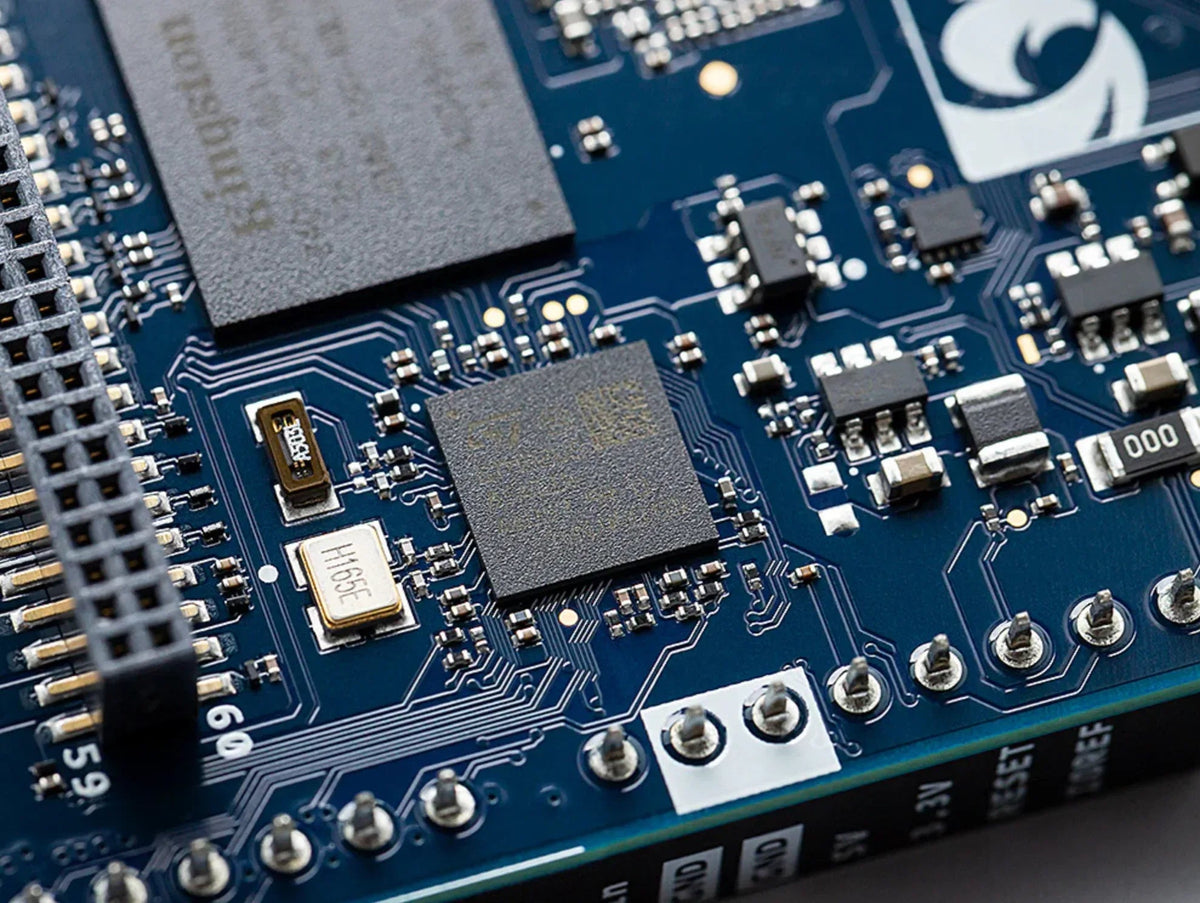
The Arduino® UNO™ Q 4GB development board combines a Qualcomm® Dragonwing™ QRB2210 microprocessor with a real-time STM32U585 microcontroller for robotics, IoT, machine vision, audio, and edge AI development. Its hybrid architecture supports Arduino Sketches alongside Python® and Linux® Debian workflows, with 4 GB LPDDR4 memory and 32 GB built-in eMMC storage for multi-process applications, local data, and more complex AI models.
The board is compatible with the Arduino UNO ecosystem, including classic UNO shields and newer carriers. A Qwiic connector supports solderless expansion with Modulino® nodes and compatible third-party modules.
Key Features
- Qualcomm Dragonwing QRB2210 microprocessor with quad-core 2.0 GHz CPU, Adreno GPU, integrated AI acceleration, and 2x ISP
- Real-time, low-power STM32U585 microcontroller
- 4 GB LPDDR4 RAM and 32 GB built-in eMMC storage
- Dual-band Wi-Fi 5 (2.4/5 GHz) and Bluetooth 5.1 connectivity
- High-speed headers for vision, audio, and display peripherals, plus classic UNO headers for shields
- 8 x 13 LED matrix for visual feedback
- USB-C connection for power delivery and video output, with support for keyboards, mice, USB microphones, and USB cameras via a dongle
- Arduino App Lab preloaded for integrated Arduino, Python, and containerized AI-model development
Specifications
| Microprocessor | Qualcomm Dragonwing QRB2210 |
| Microcontroller | STM32U585 MCU |
| CPU | Quad-core 2.0 GHz |
| GPU | Adreno GPU |
| Image Signal Processors | 2x ISP |
| Memory | 4 GB LPDDR4 |
| Built-in Storage | 32 GB eMMC |
| Wireless Connectivity | Dual-band Wi-Fi 5 (2.4/5 GHz), Bluetooth 5.1 |
| LED Matrix | 8 x 13 |
| Expansion | High-speed headers, classic UNO headers, Qwiic connector |
| USB | USB-C |
| Software | Linux Debian, Arduino IDE, Arduino Cloud, Arduino App Lab |
Development Software
Arduino App Lab provides a unified environment for building applications that combine Arduino Sketches, Python scripts, and containerized AI models. Ready-to-use Arduino Apps and pre-built Bricks are available to help accelerate prototyping. Preloaded AI models support workflows including object detection, anomaly detection, image classification, sound recognition, and keyword spotting.
Applications
Suitable for prototyping robotics, IoT, machine vision, audio processing, display-connected projects, and AI-enabled embedded applications. The onboard storage and memory support Linux single-board computer workflows, simultaneous high-level processes, local logging, and development environments.
Manuals
Arduino App Lab documentation is available at docs.arduino.cc. For product assistance, contact support@robotdoo.com.